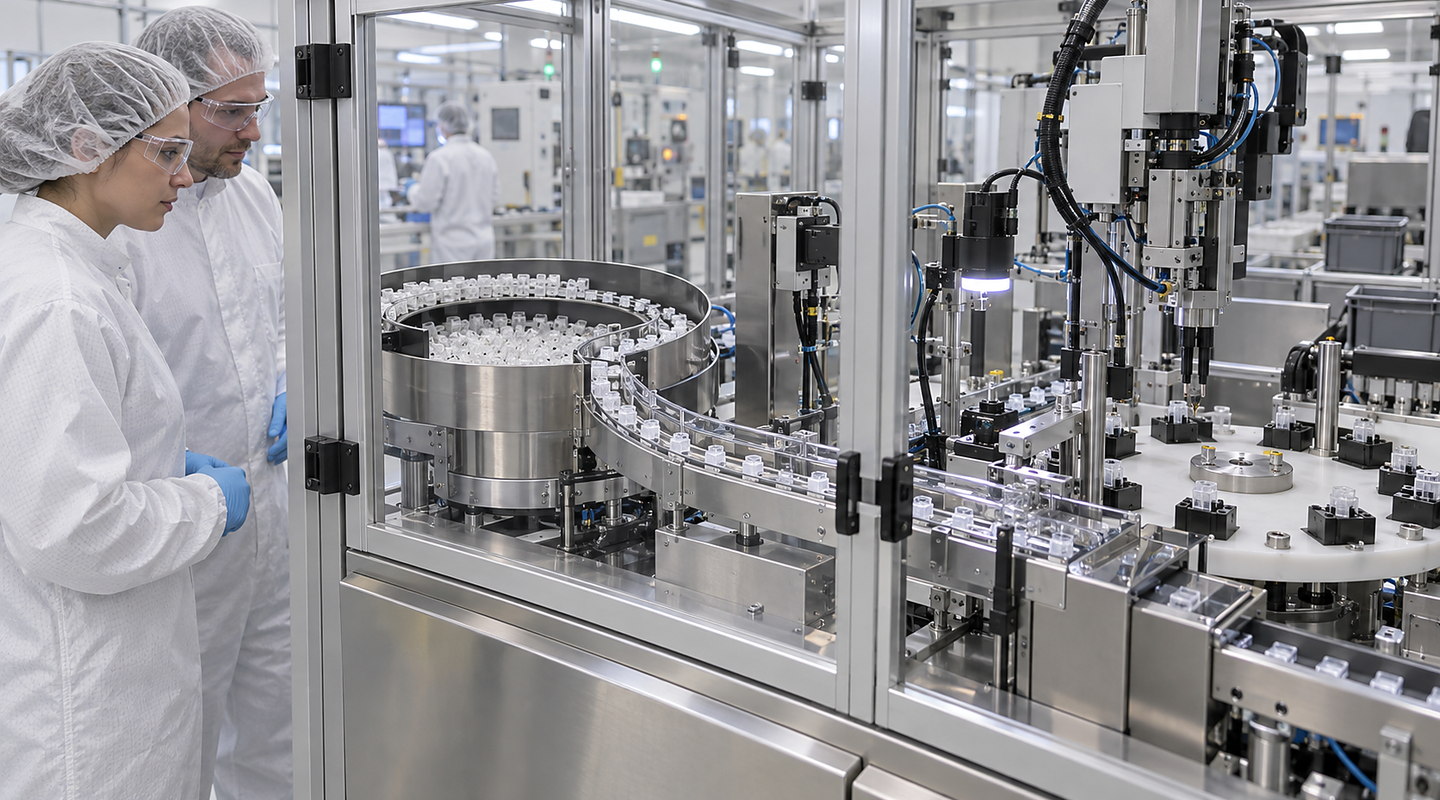
Syringe Part Feeders: How the Process Works
Follow the operating sequence for syringe part feeders, from preparing the input and controlling the main task to handling exceptions and checking results.
A syringe-component feeding project starts with the actual part variants, permitted contact areas and required assembly orientation. Trial separation and transfer, agree the downstream handover, then test usable delivery, replenishment and recovery. Use the rate and recovery checklist to agree the evidence.
For your application, the important details include component geometry and variation for syringe-component feeding & orientation, surface, fragility and entanglement behaviour, bulk condition and replenishment method, and required orientation and delivery rate.
Understand the complete route from input to accepted output — Syringe Part Feeders
Plan syringe part feeders around real component variation, bulk condition, orientation, usable delivery rate and the downstream interface. Discuss representative part trials with Sorting Solutions. Follow the material or part through each operating step and include recovery, cleaning and change in the real cycle.
Discuss your application

Four clear stages for syringe part feeders
At each stage, you can review how component geometry and variation for syringe-component feeding & orientation and jam, damage and recovery acceptance checks affect the next commitment.
- 01
Review Representative Production Components
Identify each component variant, its current drawing revision and the range represented by the samples. Include normal, marginal and supplier-variant parts, critical surfaces, permitted contact areas and manufacturer-defined handling requirements.
- 02
Trial Separation, Orientation and Presentation
Compare candidate feeding methods with the same representative component range and agreed bulk conditions. Record separation, orientation, entanglement, damage and intervention observations, including conditions not yet demonstrated.
- 03
Develop Tooling, Controls and the Downstream Interface
Agree the transfer datums, presentation at the downstream pick point and the usable delivery rate required there. Define ready, waiting, blocked and fault states with the downstream team, including the permitted recovery sequence.
- 04
Challenge Delivery, Replenishment, Jams and Recovery
Run the agreed delivery, replenishment, jam and recovery checks on the completed setup. Record the part range, settings, test conditions and results, then close or explicitly retain outstanding actions before handover.
Decisions and results stay connected
| Stage | What happens | What you can review |
|---|---|---|
| Review Representative Production Components | Confirm the requirements for syringe-component feeding and orientation, the operating range and the definition of a good result. | A component and drawing-revision register, representative sample range, permitted contact areas and required orientation. |
| Trial Separation, Orientation and Presentation | Compare workable methods using component geometry and variation for syringe-component feeding & orientation and surface, fragility and entanglement behaviour from your real production. | The trial conditions and observations for separation, orientation, entanglement, damage and interventions, with unresolved cases identified. |
| Develop Tooling, Controls and the Downstream Interface | Resolve bulk condition and replenishment method, required orientation and delivery rate and the physical, control, safety and data connections. | The transfer layout and agreed downstream states, handover conditions, usable delivery requirement and recovery responsibilities. |
| Challenge Delivery, Replenishment, Jams and Recovery | Check normal, difficult and fault conditions before your team takes over the system. | Usable-delivery and fault-recovery results for the tested part range, the accepted limits, open actions and operating information. |
Keep connected responsibilities clear
Your final syringe part feeders scope must also account for escapement and downstream pick interface, jam, damage and recovery acceptance checks, current regulations and the conditions at your site.
- Regulated-product validation and release decisions remain with the responsible manufacturer.
- Sample trials must include normal, marginal and supplier-variant components.
- Quoted feeder output is not the same as usable delivery at the downstream process.